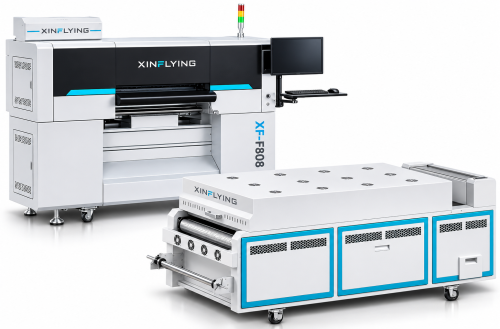

XinFlying F808 DTF Printing Machine 8 Heads Epson i3200-A1 80 cm
Equipped with a wide print format and 8 Epson printheads, this printer suits growing and large-scale businesses producing high-volume orders…

Equipped with a wide print format and 8 Epson printheads, this printer suits growing and large-scale businesses producing high-volume orders…
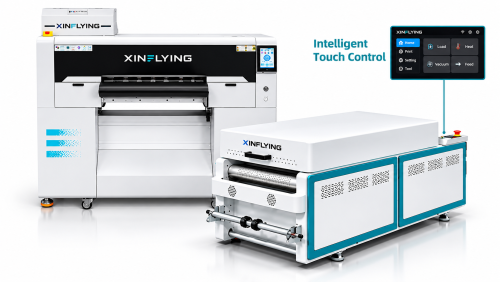
F606-6132A1+A6502 24″ 6 pcs Epson i3200-A1 Printheads DTF Printer Equipped with a wide format and 6 Epson printheads, this…
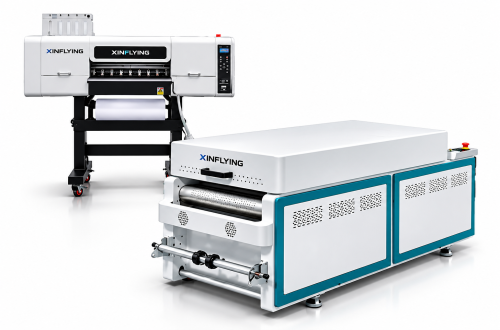
C604+H6501 24 Inch 4 pcs I3200-A1 Printheads DTF Printer Direct-to-film transfers can be applied to shoes, t-shirts, handbags, cushions,…
DTF t-shirt printing systems are roll production lines that print the design on PET film first and then transfer it to the garment with a heat press. In the XinFlying range the printer does not come alone: it is installed together with a shaker unit that handles powdering, curing and film rewinding. The printed film is powdered, passes through the oven and is wound back onto a roll. All that is left in the workshop is the press.
For a t-shirt producer, the real gain is flexibility. The same film goes onto a cotton tee, a polyester jersey or a dark sweatshirt, with no pre-treatment on the fabric. When orders come in mixed, dozens of small designs are nested side by side on one film (gang sheet) and printed in a single run. Waste drops, and there is no need to set up separately for each item.
All three machines in the series use Epson i3200-A1 heads; the difference lies in the number of heads, the print width and therefore the daily output.
The first number to look at when choosing a model is your daily transfer output. If you print a few rolls a day, 60 cm is enough; on a line running in shifts, 80 cm and more heads bring the cost per metre down noticeably.
In DTF, wash resistance and colour vibrancy do not depend on the machine alone. Ink, film and adhesive powder have to work together. Because XinFlying produces all three itself, the machine settings arrive matched to the consumables. You can find compatible products on our DTF printing inks and supplies page. White ink care deserves its own attention; our article on DTF white ink clogging covers the daily maintenance routine.
To see how the technique works step by step, read our guide what is a DTF printing machine. If you are looking for printing directly onto finished garments, take a look at our DTG pigment t-shirt printing systems category.
It can be applied to cotton, polyester, cotton-poly blends, nylon and leather-like surfaces. Since the ink bonds to the adhesive powder layer rather than the fibre, it also gives vivid results on dark garments thanks to the white underbase.
With compatible ink, film and powder and the right press temperature and time, prints last through dozens of washes without cracking or fading. The single biggest factor is the powder melting fully in the oven.
The machine ships with its shaker unit, so powdering and curing are covered. A heat press to transfer onto the garment and a computer to run the standard RIP software are all you need on top.
Look at your daily output. For shops printing a few rolls a day the 4-head C604 is enough. For businesses taking wholesale orders and running the machine all day, the 8-head F808 pays for itself faster in both speed and cost per metre.