


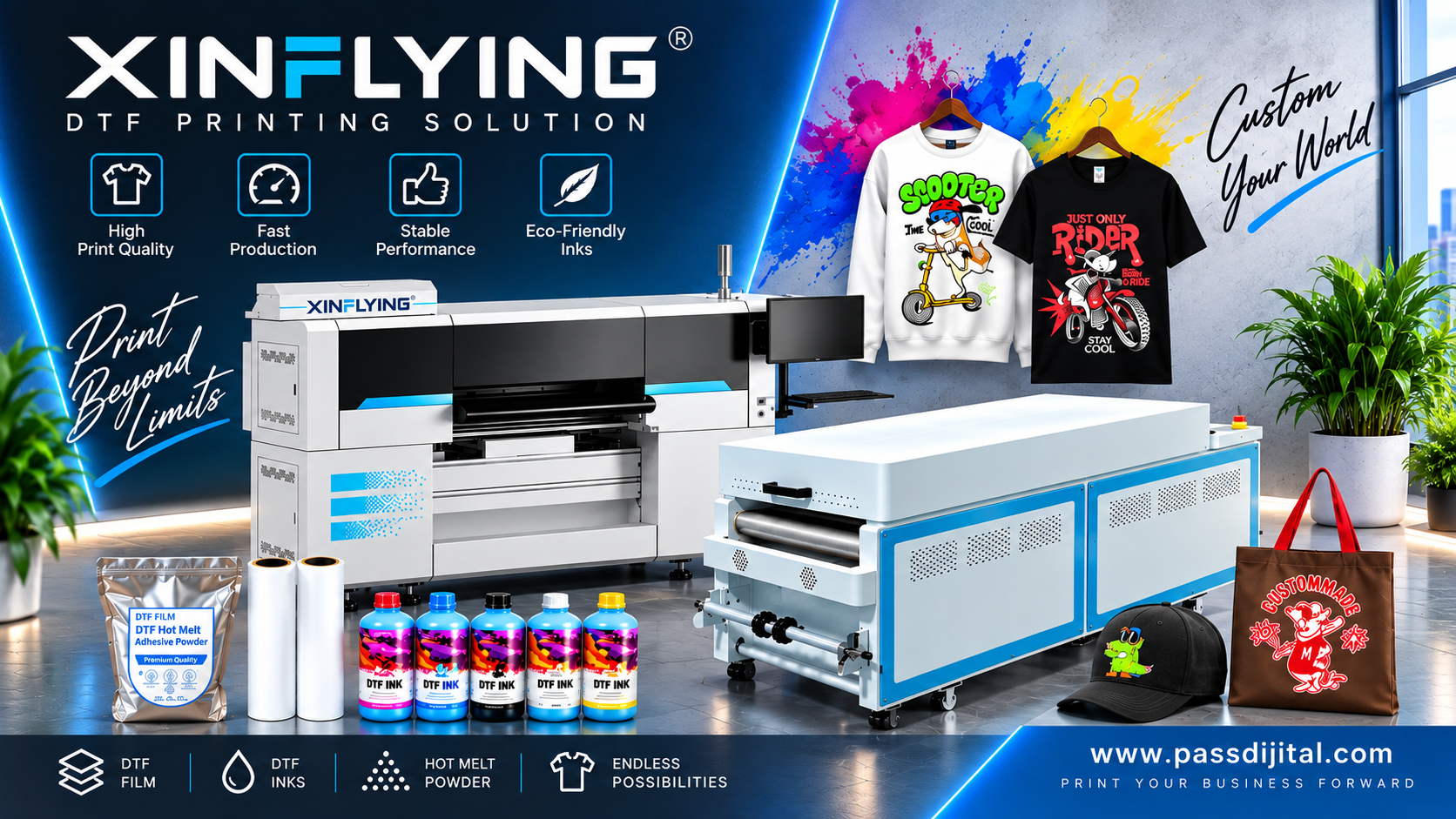
A DTF (Direct to Film) printing machine is a digital textile printing system used to print digital designs onto special PET film and then transfer them onto textile products with heat and pressure. Instead of bonding chemically with the fibre, the ink forms a thin layer on the surface, which is why DTF is far more flexible about fabric type than other textile printing methods.
The technology is used for colourful, highly detailed prints on cotton, polyester and blended fabrics, above all t-shirts, sweatshirts, bags, workwear and sportswear. Unlike sublimation it also works on dark backgrounds, because an opaque white layer is printed beneath the colours.
How DTF printing works step by step
DTF production is not completed on a single machine but in three consecutive stages: printing onto film, powdering and curing, and finally transfer onto the product.
The printing stage
1. The design is prepared.
The print file is prepared in a program such as Photoshop, Illustrator or CorelDRAW, then colour settings and white channel separation are handled in the RIP software. Where the white layer will be printed is decided at this stage.
2. The design is printed onto PET film.
The printer applies the design to special DTF PET film using CMYK colours and white ink. Colours are printed first and white second, so the correct order appears once the film is turned over.
3. White ink creates the opaque layer.
White ink acts as a covering layer behind the colours. It is the sole reason colours stay vivid on black and dark fabrics; if the white channel is not printed properly the design looks faded and grey.
Powdering and curing
4. Adhesive powder is applied.
Hot-melt DTF powder is sprinkled onto the still-wet ink of the printed film. This powder is the thermoplastic adhesive that will bond the print to the fabric, and it adheres only where ink is present.
5. The powder is melted at a controlled temperature.
The film passes through a shaker or drying unit where the powder is melted and bonded to the printed surface. If the temperature is too low the powder does not melt fully and the transfer lifts in the wash; if it is too high the film deforms.
Transfer and peeling
6. It is transferred with a heat press.
The prepared film is placed onto the textile product and transferred under a set temperature, time and pressure with a heat press. Unless all three variables are correct together, adhesion stays weak.
7. The film is peeled off.
Once the transfer is complete the PET film is separated from the fabric and the design remains on the product. Depending on the film type, peeling is done while hot or after cooling; peeling at the wrong moment damages the edges of the print.
Components of a DTF system
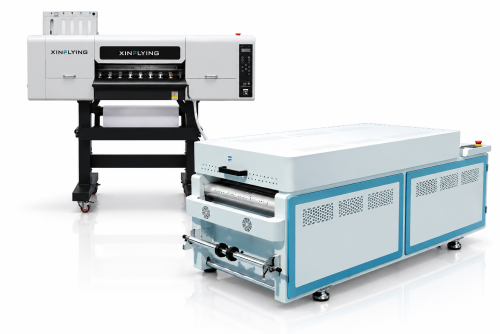
An investment decision in DTF cannot be made by looking at the printer alone. The production flow consists of this chain:
Design → RIP software → DTF printer → PET film → adhesive powder → shaker / drying unit → heat press → textile product
Every link in the chain affects the result. Printhead resolution and white ink circulation determine print quality, powder quality and curing temperature determine wash durability, and the pressure balance of the heat press determines whether the transfer lifts at the edges. This is why the powder shaker and drying unit supplied with the printer should be assessed alongside the machine itself.
What print width actually means
DTF machines are produced in different print widths according to application and production capacity. Three options are the most common on the market:
| Print width | Typical use | Production capacity |
|---|---|---|
| 30 cm | Boutique production, entry-level workshop | Low / medium |
| 60 cm | Workshop running professional production | Medium / high |
| 80 cm | Serial and industrial textile production | High |
A common misconception needs correcting here: width determines capacity, not print quality. If a 30 cm and an 80 cm machine use the same printhead technology, the resolution and colour of the output are identical. What changes is how wide a film can be printed in one pass, and therefore how many square metres per hour can be produced.
In practice the deciding factor is your daily transfer output. For low and medium volumes 60 cm models are enough, while in regular series production models of 80 cm with more printheads noticeably reduce unit cost. The DTF printing machines offered by Pass Dijital are configured in 60 and 80 cm widths, together with their powder shaker and drying units.
Print durability and applications
A correctly applied DTF transfer withstands dozens of washes. Because the print forms a thin film layer on the surface it can be felt slightly by hand; this comes from the nature of the method and is not a sign of poor quality. How thin that layer is depends on powder quantity and press settings.
The most common applications are personalised t-shirt and sweatshirt production, corporate workwear and promotional textiles, sports jerseys, and promotional items such as bags and caps. Because many different designs can be arranged on one film and produced in a single pass, it is also economical for low-quantity orders.
Common mistakes
Most DTF problems come not from the machine but from process settings. These are the ones seen most often:
- Insufficient curing: a print transferred before the powder has fully melted cracks or lifts at the first wash.
- Neglecting the white channel: when the white layer is generated incorrectly in the RIP, colours come out faded on dark fabric.
- Peeling at the wrong time: peeling a hot-peel film after it has cooled damages the edges.
- Letting white ink stand: its pigment is heavy and settles, so nozzles clog on machines without circulation.
- Unsuitable fabric choice: adhesion stays weak on water-repellent or heavily finished fabrics, so a sample should be tested first.
Popular DTF Printing Machine Models
| Fotoğraf | Ürün Kodu | Ürün Adı | Detaylı Bilgi |
|---|---|---|---|
|
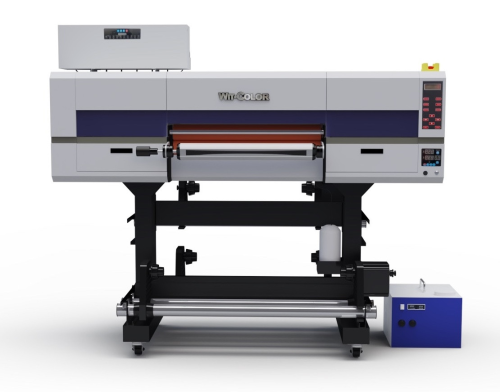
UV DTF | UV DTF Printing Machine 0603 | Review |
|
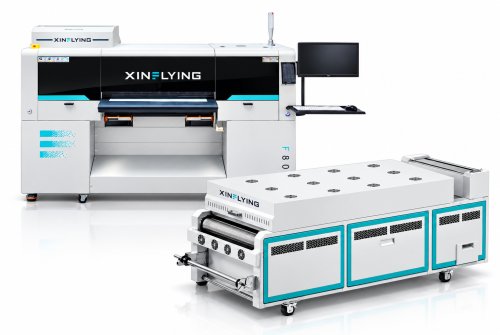
XinFlying F808 | DTF Printing Machine 8 Heads Epson i3200-A1 80 cm | Review |
|
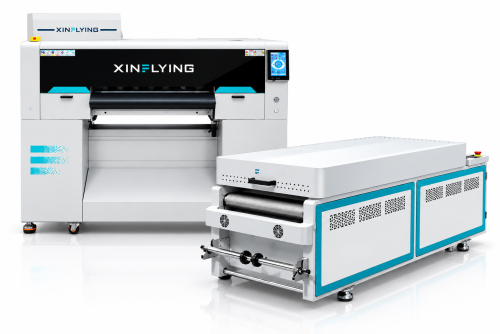
XinFlying F606 | DTF Printing Machine 6 Heads Epson i3200-A1 60 cm | Review |
|
XinFlying C604 | DTF Printing Machine 4 Heads Epson i3200-A1 60 cm | Review |
Frequently Asked Questions About DTF Printing Machines
1. Which fabrics does DTF printing work on?
Because the ink forms no chemical bond with the fibre, DTF is flexible about fabric type. It can be used on a wide group including cotton, polyester, blended fabrics, leather and dark-coloured backgrounds. Adhesion may weaken on water-repellent coatings and heavily finished fabrics, so a sample should be tested before production.
2. What is the difference between DTF and sublimation?
In sublimation the dye turns to gas under heat and penetrates the polyester fibre; it works only on light-coloured polyester and the print cannot be felt. In DTF the print forms a layer on the surface and also delivers results on cotton and dark fabrics. If your fabric is cotton, sublimation is not an option.
3. Do I have to buy a separate heat press?
Yes. The DTF printer and shaker unit prepare the film, but the transfer itself is made with a heat press. The press must be able to control temperature, time and pressure simultaneously. Attempts with a household iron cannot distribute pressure evenly and do not give lasting results.
4. Does the print come off in the wash?
If the powder is applied in the right quantity, fully melted, and the press settings are correct, the print withstands dozens of washes. Most complaints about lifting stem from insufficient curing or low press pressure. Washing inside out at a low temperature extends print life.
5. How much space and what conditions does a DTF machine need?
Because the printer and shaker unit sit side by side, a 60 cm system needs roughly 4-5 square metres and an 80 cm system more. Keeping the room free of dust and holding temperature and humidity steady noticeably extends printhead life.