


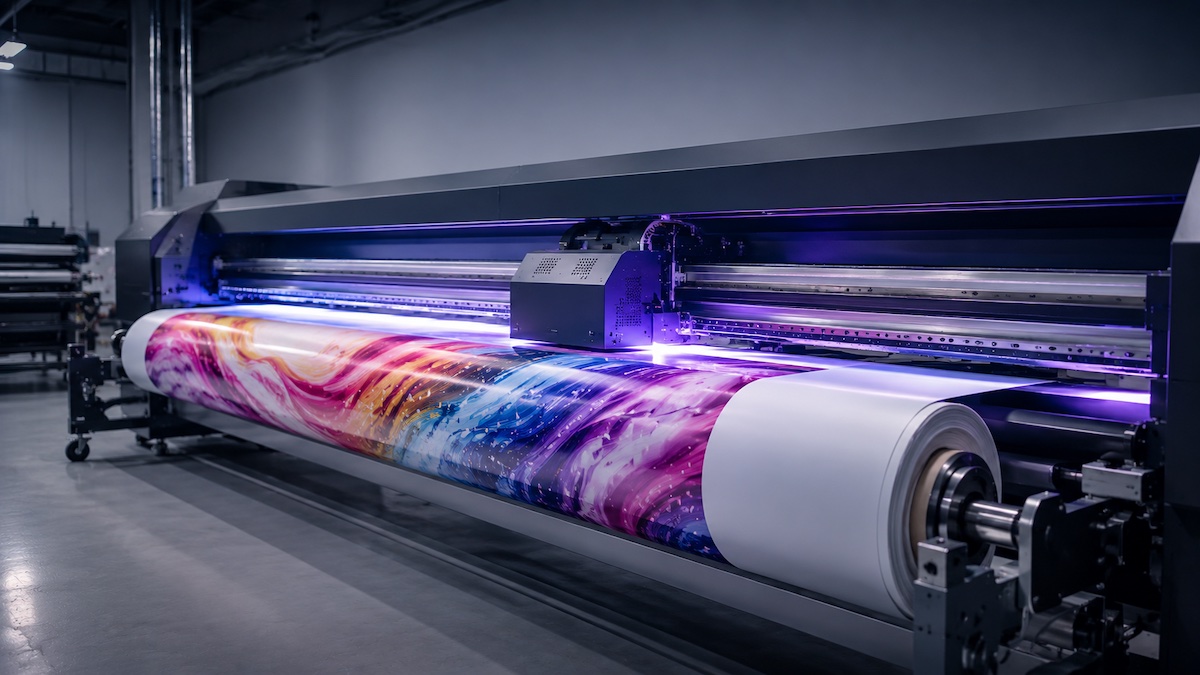
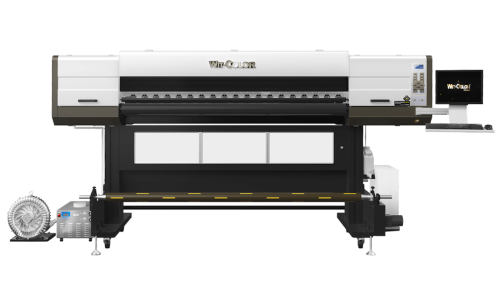
Roll to roll UV printing machines are digital printing systems that run continuous production by processing flexible media such as vinyl, banner, film and textile in roll form. The material unwinds from a feed roll, passes beneath the printheads and rewinds at the other end. Because the operator does not have to load sheets one by one, production becomes largely automated.
The key feature separating these systems from classic solvent and ecosolvent machines is that the ink cures at the moment of printing under ultraviolet light. As the material leaves the machine it is dry and ready to use; no drying rack, waiting time or extra ventilation is required.
How roll to roll UV printing works
As the printhead travels left and right across the material, it deposits ink droplets onto the surface. UV lamps positioned immediately behind the head solidify the ink before it has a chance to spread. This instant curing produces two results: dot sharpness is preserved and the material is dry at the output.
LED UV versus mercury lamps
Traditional mercury vapour lamps generate high heat and can deform heat-sensitive materials such as thin film. LED UV systems run at a significantly lower temperature, consume less energy and offer a far longer lamp life. For businesses working with thin, flexible media, LED UV is in practice the only sensible option.
The effect of printhead technology
Printhead technology determines both speed and resolution. Kyocera and Ricoh Gen6 heads suit serial production with their high droplet frequency and industrial durability. Konica heads are preferred for wide-format work. Epson i3200 stands out for fine detail and, thanks to wide spare part availability, keeps maintenance costs predictable.
How to choose the print width
Width selection is the most common mistake in machine investment. What matters is not the size of the largest job you produce, but the size of the job you produce regularly.
The cost of printing wide jobs on a narrow machine
If a wide job will not fit through the machine, it is split and the pieces are joined. That means seams: visual integrity suffers, installation takes longer and labour cost is incurred per seam. For work expected in one piece, such as facade banners and billboards, this is not acceptable.
The cost of printing narrow jobs on a wide machine
The opposite also carries a loss. In a business constantly printing one-metre jobs, a 3.2 metre machine represents idle capacity in both purchase and running cost. Head cleaning, ink circulation and maintenance expenses all rise with machine width.
When double-sided printing is needed
Double-sided models print in register on both faces of the material. Applications such as hanging flags, signage viewed from both sides and lightbox graphics are finished in a single pass. On a single-sided machine the same job requires turning the material and printing again, which means both a registration risk and twice the time.
If you only produce work seen from one side, paying for the double-sided capability offers no return. The decision should be made by looking at the proportion of double-sided work in your job portfolio.
Which materials it works with
Roll to roll UV systems work on vinyl, banner, mesh, film, canvas, wallpaper and some textile surfaces. Because UV ink cures on the surface rather than soaking into it, it also adheres to non-absorbent media. This means a wider material range than ecosolvent and solvent systems.
If transfer to rigid and curved materials is required instead of direct printing, the UV DTF options in the UV printing machines category can be considered. For direct printing onto rigid boards, flatbed UV printing machines are suitable.
Roll to roll or hybrid
If you only print roll media, a dedicated roll to roll machine is the most efficient solution; it is mechanically designed for that job. However, if your portfolio regularly includes rigid boards as well, hybrid UV printers combine two separate system investments into one machine, saving both space and capital.
The decision criterion is simple: if board work is a small and irregular part of your total production, outsourcing those jobs may be more economical than buying a hybrid machine.
Maintenance and running cost
Because UV ink does not tend to dry out, the risk of head clogging is lower than on solvent machines. In return, UV lamps and the curing unit require periodic inspection. LED UV lamps have a long life but not an infinite one; when light intensity drops, curing quality drops with it and the print may remain tacky on the surface.
Daily routines of head cleaning, filter inspection and cleaning of the roll feed mechanism are recommended. On a regularly maintained machine, unexpected downtime falls noticeably.
Popular Roll to Roll UV Printing Machine Models
| Fotoğraf | Ürün Kodu | Ürün Adı | Detaylı Bilgi |
|---|---|---|---|
|
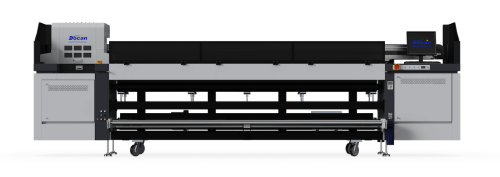
Docan UV S3200 | Kyocera, Ricoh and Konica Printhead Options | Review |
|
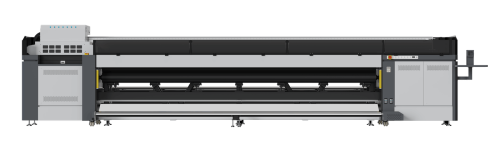
Docan UV R5200 | Roll to Roll UV Printing Machine | Review |
|
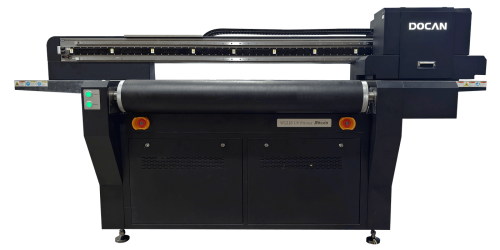
Docan UV W1216 | Roll to Roll UV Printing Machine | Review |
|
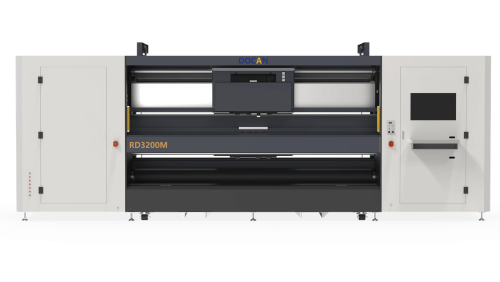
Docan UV RD3200 | Roll to Roll UV Double-sided Printing Machine | Review |
|
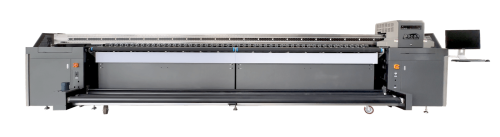
Docan UV Eco U5300 | Industrial Roll to Roll UV Printing Machine | Review |
|
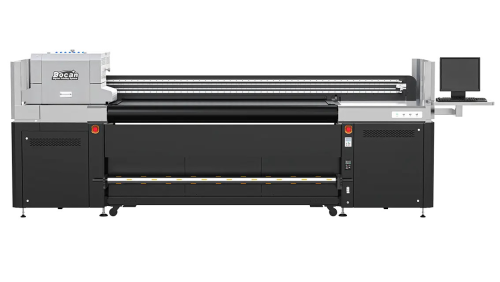
Docan UV FR2006 | Roll to Roll UV Printing Machine | Review |
|
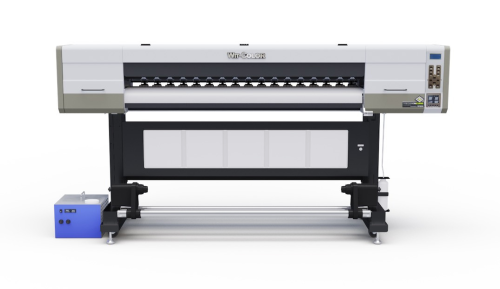
UV Ultra i3200 1702 | Roll to Roll UV 1.6m Epson i3200 1702UV | Review |
|
Ultra i3200 2003 UV | Roll to Roll 1.9m Belt UV Epson i3200 2004UV | Review |
Frequently Asked Questions About Roll to Roll UV Printing Machines
1. What determines print speed on a roll to roll UV machine?
Speed is determined by the number of printheads, head technology, the chosen resolution and the number of passes. On the same machine, speed drops in high quality mode and rises in production mode. You should therefore consider the speed in the quality mode you will actually work in, not the maximum figure in the catalogue.
2. Does UV printing require lamination?
In most applications it does not; UV ink is already resistant to scratching and UV light. However, for work with heavy mechanical contact such as floor graphics and vehicle wrapping, protective lamination extends print life significantly.
3. Can both UV and ecosolvent ink be used in the same machine?
No. The ink system, head structure and curing unit are specific to the technology. Switching to a different ink type requires changing the entire relevant line of the machine, which in practice means buying a separate machine.
4. Does it make sense to buy a used roll to roll machine?
A used machine bought without knowing the head condition and total print counter carries high risk. The cost of head replacement often makes up a significant portion of the machine price. A head test, line check and review of the service history are essential before purchase.
5. What environmental conditions does the machine require?
UV systems run more stably at a constant temperature and humidity level. Very dusty environments shorten head life. Sufficient clear space must also be left on the feed and rewind sides of the machine for material movement.