
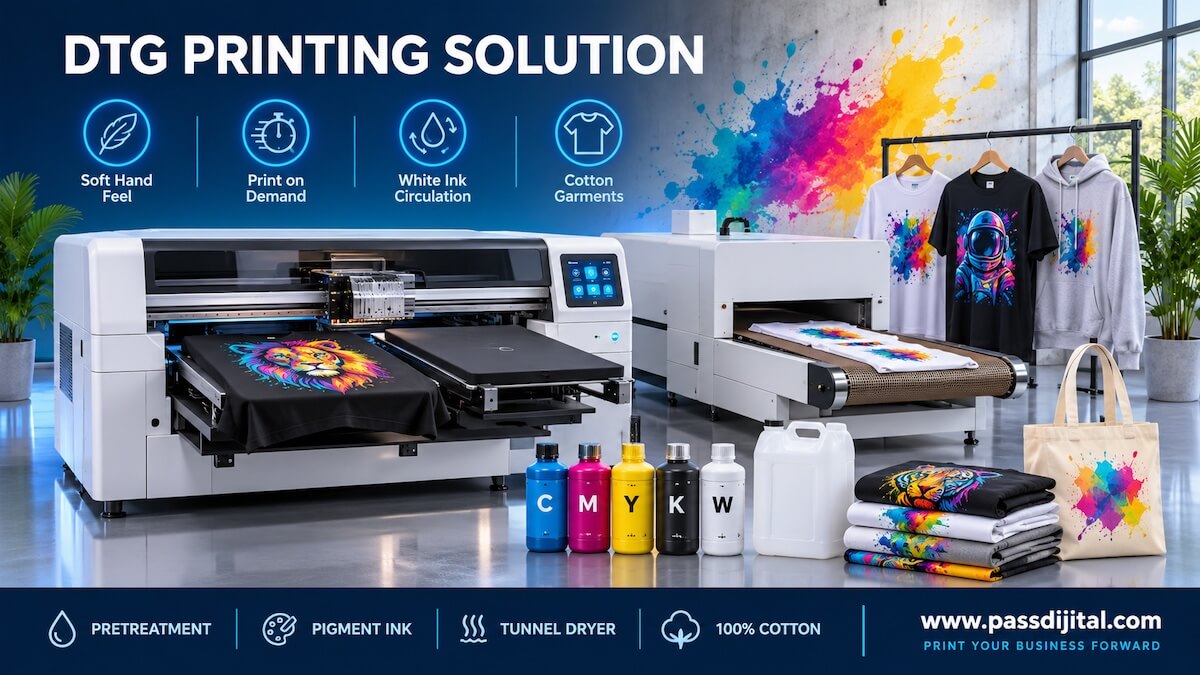
A DTG (Direct to Garment) printing machine is a digital textile printing system that prints a design straight onto finished garments such as T-shirts, sweatshirts and tote bags, with no intermediate material. It works much like an inkjet printer; the difference is that a T-shirt stretched on a platen takes the place of the paper, and the ink is a textile pigment formulated to work its way into cotton fibre.
What people like most about the method is the hand feel. The print does not sit on top of the fabric as a layer, it goes into the fibre; run your hand across the shirt and you will barely feel where the print begins. Since a single order needs no screens, plates or film, it also stays affordable for personalised and short-run work.
How DTG printing works
Getting a T-shirt from the machine to the packing table takes five steps. Two of them come before printing and two after, and these in-between steps usually decide the quality more than the machine itself.
1. The file is prepared in the RIP software.
The design is loaded into the RIP, a colour profile is assigned and the white channel is built. On a dark shirt, this is where you decide where the white underbase goes and how dense it should be.
2. Pretreatment is applied to the fabric.
Pretreatment liquid stops the white ink from sinking between the fibres and helps the pigment hold on the surface. It is essential on dark garments; on light colours it is used more sparingly, or not at all, depending on the ink and the vibrancy you want. The treated area is dried in a heat press before printing.
3. The shirt is loaded on the platen and printed.
The garment is laid flat and taut on the platen. The printheads lay down the white underbase first and then the CMYK colours. Newer machines can print white and colour in the same pass, which shortens the time per shirt.
4. The ink is cured.
Once the print is done, heat is applied so the pigment bonds permanently to the fabric, either with a heat press or a conveyor tunnel dryer. If curing falls short, the print fades in the first few washes; most wash-fastness complaints trace back to this step.
5. The garment is checked.
Pretreatment sometimes leaves a faint box mark around the print area. It usually disappears in the first wash, but if the same mark shows up clearly across a whole batch, the amount of liquid needs to come down.
Which fabrics can be printed with DTG
DTG pigment is designed to bond with cotton. The best results come on 100% cotton T-shirts; as the cotton content drops, so do colour saturation and wash fastness. For the XinFlying DTG machines supplied by Pass Dijital, the manufacturer recommends garments with more than 50% cotton.
In practice, the items most often printed with DTG are cotton T-shirts and sweatshirts, canvas and tote bags, aprons and cotton accessories. Polyester-heavy sportswear is a different story: pretreatment does not work properly on polyester and the white underbase does not hold well. For these products, sublimation printing machines or DTF give far more reliable results. With blended fabrics, always run a sample before deciding.
Differences between DTG and DTF
Both technologies print T-shirts and serve the same customers, so they are often confused. The key difference is how the ink reaches the fabric: directly with DTG, and with DTF by printing onto PET film first and transferring it to the fabric with adhesive powder. We cover the steps of a DTF printing machine in a separate article; here are the two side by side.
| Feature | DTG | DTF |
|---|---|---|
| Printing method | Directly onto the garment | Onto PET film, then onto the garment with a heat press |
| Suitable fabrics | Cotton and cotton-rich blends | Cotton, polyester, blends, leather |
| Hand feel | Print sits in the fibre, barely felt | Thin layer on the surface, slightly felt |
| Pretreatment | Needed on every dark garment | Not needed |
| Consumables | Ink and pretreatment liquid | Ink, PET film and adhesive powder |
| Production | Each garment printed one by one | Designs ganged on film, transfers can be stocked |
The decision usually comes down to your order profile. If your customers mostly want cotton T-shirts and care about a print they cannot feel, DTG comes out ahead. If you need to print a polyester jersey, a cotton sweatshirt and a cap on the same day, DTF is more flexible. Many shops end up running both as their volume grows.
What to look for when choosing a DTG machine
Printheads and the white ink system
White ink pigment is heavy and settles when it stands still. In a system without circulation, that means clogged heads and streaks on the first prints of the morning. When choosing a machine, always ask whether the white channel is circulated continuously and how the capping and cleaning station works. On the head side, the Epson i3200-A1 is currently the most widely used industrial head in DTG machines; more heads means the same quality in less time.
Pretreatment inside or outside the machine
In a traditional setup, pretreatment is sprayed by a separate machine, the shirt is dried in a press and then carried to the printer. That adds two extra handling steps for every garment. Systems that pretreat and print in the same body combine these steps, and in a shop printing hundreds of shirts a day the time saved adds up fast.
Platen size and real output
Platen size sets the largest design you can print. A 400 × 500 mm platen covers almost every front and back print on a T-shirt. For speed, ignore the headline figure in the brochure and look at pieces per hour in the quality mode you will actually use. The XinFlying DTG-10, for example, delivers about 45 A4 prints or 23 A3 prints per hour in 6-pass mode. On the double-station DTG-20, the next shirt is loaded on the second platen while the first is printing, so the operator never waits and the pace approaches one shirt a minute.
Curing capacity
As the printer gets faster, the bottleneck moves to curing. A single heat press can only cure so many shirts an hour; if the printer turns out more than that, shirts pile up in front of the press. That is why production lines use a conveyor tunnel dryer: the shirt cures as it travels along the belt, and the operator simply loads and unloads.
Room conditions and spare parts
DTG machines are sensitive to temperature and humidity. Manufacturer specifications usually sit around 20–28 °C and 35–65% relative humidity; in a dry workshop the nozzles clog far more often. It is worth checking in advance whether the room can hold these conditions all year round. Being able to get spare heads, dampers and ink from local stock matters as much as the machine itself, because every day of downtime shows up directly in your orders.
Common mistakes
Most bad DTG results come from preparation and settings rather than the machine. The ones we see most often in workshops:
- Too much pretreatment: leaves a permanent mark around the print and a stiff hand. Too little makes the white look pale and speckled.
- Printing without flattening the shirt: raised fibres get trapped under the white underbase and small dots appear after washing. A few seconds in the press before printing lays the fibres down.
- Under-curing: the print looks perfect at first and the problem only shows in the first wash. Temperature and time should follow the ink manufacturer's figures.
- Trying DTG on polyester-heavy garments: colours stay dull and wash fastness drops.
- Leaving the machine off for days: white ink settles when it does not circulate. Even on days without production, the machine should stay on and in its automatic maintenance cycle.
Which businesses DTG suits
DTG is strongest where every order differs from the last. E-commerce brands that print T-shirts as orders come in, personalisation shops, design labels producing collections in small batches and promotional companies preparing short runs of branded textiles for corporate clients are typical DTG users. Printing only what has been sold, without holding stock, noticeably eases the cash burden on these businesses.
For orders of thousands of pieces with a single design, screen printing still wins on unit cost. It is more realistic to see DTG not as a replacement for screen printing, but as the machine for the small, varied jobs where screen printing does not pay. Pass Dijital's DTG T-shirt printing machines come in single and double-station versions and can be configured with a tunnel dryer. Get in touch and we will work out the capacity you need together.
Popular DTG Printing Machine Models
| Fotoğraf | Ürün Kodu | Ürün Adı | Detaylı Bilgi |
|---|---|---|---|
|
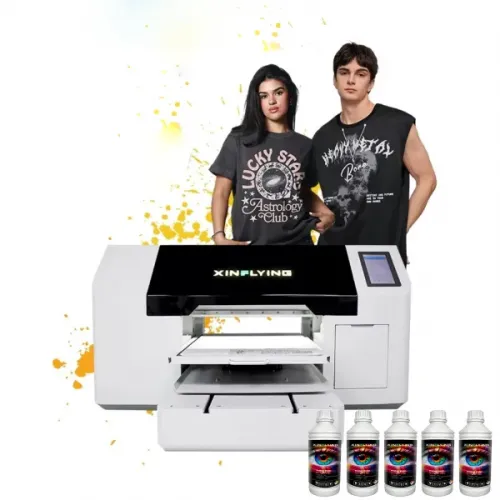
XinFlying DTG-10 | DTG T-Shirt Printing Machine Epson i3200-A1 | Review |
|
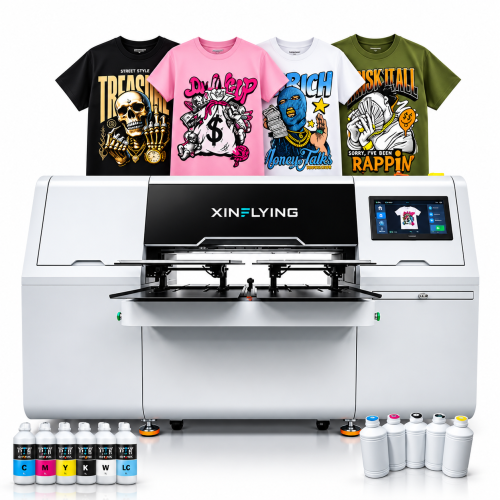
XinFlying DTG-20 | Double Station DTG T-Shirt Printing Machine 4 Heads Epson i3200-A1 | Review |
Frequently Asked Questions About DTG Printing Machines
1. Is DTG printing wash-resistant?
With correct pretreatment and full curing, a DTG print on a cotton T-shirt survives dozens of washes. Washing the shirt inside out at a low temperature and keeping it out of the tumble dryer extends the life of the print. Early fading is usually a sign of under-curing.
2. Can DTG print on dark T-shirts?
Yes. On a dark garment a white underbase is printed first and the colours go on top of it. Pretreatment is essential for this. Because white ink consumption also rises, the unit cost of a dark shirt is higher than a light one.
3. Can DTG print on polyester fabric?
Pigment DTG is designed for cotton, so on polyester-heavy fabrics colour saturation and durability stay low. Sublimation is the better choice for polyester items such as sports jerseys, and DTF for orders that mix different fabrics.
4. Do I need a separate heat press or dryer for DTG?
Yes. The printer only prints; the ink needs heat to become permanent. A heat press is enough for low volumes, while a conveyor tunnel dryer removes the bottleneck when you are printing dozens of shirts an hour.
5. Is it economical to print a single T-shirt?
This is where DTG is at its strongest. With no screens, plates or film to prepare, the first piece and the hundredth take the same setup time. The cost is driven mainly by ink consumption, pretreatment liquid and labour.